

Bulk Waste Removal for Construction: A Strategic Guide to Site Efficiency (2026)

 Effective bulk waste removal for construction is more than a simple clearance task; it is a critical component of site logistics that directly impacts project timelines, safety, and financial performance. For project managers and procurement officers overseeing large-scale developments, managing the vast quantities of rubble, soil, timber, and other materials is a significant administrative and regulatory challenge. A strategic approach is essential to navigate rising disposal costs and complex compliance obligations. 

This guide provides a framework for transforming your construction waste management from a reactive necessity into a proactive strategy. By focusing on efficient logistics, data-driven cost control, and regulatory foresight, you can enhance site efficiency, meet sustainability targets, and reduce the administrative burden on your team. 

The Fundamentals of Bulk Waste Removal for Construction

Bulk waste removal is the systematic management and clearance of large-volume materials generated during construction, demolition, and excavation. Its timely execution is fundamental to maintaining a safe, organised worksite and preventing costly project delays. Under UK law, all construction firms have a legal “Duty of Care” to ensure their waste is handled, transported, and disposed of responsibly, from the moment it is created until its final destination. 

Engaging a professional waste management partner shifts this complex responsibility to a specialist, reducing the administrative burden of handling multiple waste streams and ensuring every stage of the process is compliant and fully documented. 

Navigating UK Waste Regulations and Compliance 

Adhering to environmental legislation is non-negotiable. For every load of non-hazardous waste that leaves your site, a Waste Transfer Note (WTN) must be completed, providing an audit trail for the Environment Agency. Failure to use a licensed waste carrier can lead to significant fines and severe reputational damage. Furthermore, with Energy from Waste (EfW) facilities joining the UK’s Emission Trading Scheme (ETS), the financial incentives for recycling over disposal are set to increase, making compliance a cornerstone of cost-effective site management. 

Identifying Different Construction Waste Streams 

Effective waste management begins with proper segregation at the source. This practice not only maximises recycling rates but also significantly reduces costs associated with mixed-waste disposal. Construction waste is typically categorised into three main streams: 

  • Inert Waste: Materials like rubble, concrete, bricks, and soil that do not decompose. 
  • Non-Hazardous Waste: Common materials such as timber, plastics, and metals. 
  • Hazardous Waste: Substances that pose a risk to human health or the environment, including asbestos, solvents, paints, and materials containing Persistent Organic Pollutants (POPs) – toxic chemicals that require specialist handling and disposal protocols. 

Logistical Solutions for Large-Scale Site Clearance

The logistics of bulk waste removal must be tailored to the unique demands of each construction phase, from groundworks to final fit-out. A bespoke collection schedule ensures waste containers are delivered and exchanged without disrupting site traffic or the movement of plant machinery. This prevents bottlenecks and keeps the project on programme. 

Different materials also require specific logistical solutions. “Muck away” services are essential for the efficient removal of soil and hardcore during excavation, whilst specialist handling is required for waste streams like glazing or hazardous chemicals to ensure safe and compliant disposal. 

Choosing the Right Capacity: From Skips to RoRos 

Selecting the right container is vital for logistical efficiency and cost control. While standard skips are suitable for smaller projects, high-volume sites benefit from Roll-on Roll-off (RoRo) containers. A 20-yard RoRo is ideal for heavy, dense materials like soil and rubble, whereas a 40-yard RoRo provides the necessary volume for lighter, bulkier waste such as timber and plastics. For sites generating large amounts of packaging, compactor skips can further reduce transport frequency and cost. A comprehensive construction waste management plan will identify the optimal container solution for every stream, including complex glazing or chemical waste. 

The Impact of Hazardous Material Management 

Managing hazardous materials is a critical aspect of site safety and legal compliance. The process involves correctly identifying and securely containing substances like asbestos or chemical solvents to prevent site contamination and protect personnel. When these materials are moved off-site, a formal Consignment Note must be used in place of a standard WTN, detailing the nature of the waste and its journey to a licensed disposal facility. For detailed guidance on meeting these stringent requirements, our hazardous waste disposal services offer full compliance support. 

Optimising Costs and Sustainability in Bulk Removal

With the standard rate of Landfill Tax at £130.75 per tonne, diverting waste from landfill is no longer just an environmental goal – it is a financial necessity. A “Zero Waste to Landfill” strategy, supported by robust segregation and recycling, is the most effective way to control escalating disposal costs. 

Modern waste management leverages data to achieve this. Real-time reporting allows site managers to track waste volumes, monitor recycling rates, and identify inefficient practices. For companies managing multiple UK sites, a single, centralised invoicing system simplifies administration and provides a clear overview of total project spend. A free, no-obligation waste audit can often uncover these hidden costs and reveal immediate opportunities for savings. 

Leveraging Data for ESG and Reporting 

Transparent data is essential for meeting corporate Environmental, Social, and Governance (ESG) objectives. An online portal providing full traceability of all waste movements allows you to demonstrate compliance and report on sustainability performance with confidence. This data enables site managers to compare performance across different projects, driving best practices throughout the organisation. Accurate waste data is also a key component of maintaining ISO 14001, the international standard for environmental management systems. 

Maximising Recycling Rates for Construction Materials 

A strong recycling programme can turn waste into a resource. Recycled aggregates, for example, have a healthy secondary market and their use can help offset disposal costs. Staying ahead of legislation is also key; the government’s “Simpler Recycling” framework, set to be fully implemented by 2026, will mandate the segregation of specific materials for all businesses. The most effective strategy, however, is to reduce waste at the source through improved material procurement, just-in-time delivery, and careful on-site handling. 

Partnering for Success: The Bespoke Management Advantage

For large-scale construction projects, a strategic waste management partnership delivers far greater value than transactional “man and van” or simple skip hire services. A dedicated partner acts as an extension of your site team, developing a bespoke strategy that aligns with your project goals, budget, and compliance needs. At Red Kite Recycling, our no-contract business model ensures we are retained on service quality alone, giving you the flexibility and assurance you need. As a trusted national provider, we have the infrastructure to deliver a consistent, reliable service across all your UK sites, establishing us as a dependable partner in the industry. For more about our approach, please see our about us page. 

Why a Nationwide Partner Outperforms Localised Solutions 

Managing multiple local suppliers across a national portfolio of projects creates significant administrative complexity. A single nationwide partner simplifies this entirely. Centralised administration, reporting, and invoicing streamline your back-office functions, while a single point of contact ensures clear communication and accountability. This national coverage guarantees a consistently high standard of service, regardless of project location. Our client retention rate stands as a testament to the reliability and effectiveness of this model.
 

Cost Control 

Managing the budget and exercising cost control is key. Using multiple suppliers places the burden of financial reporting on the site management team. Co-ordinated services provide consolidated reporting and financial reporting. Management metrics across sites and purchase order control support efficient cost management. 

Initiating Your Site Waste Strategy 

The first step towards a more efficient system is a comprehensive assessment of your current waste streams and logistical needs. A free, no-obligation waste audit provides a detailed analysis of your operations, identifying immediate opportunities to improve recycling rates and reduce costs. This process is designed to create a tailored strategy that removes administrative burdens, allowing your contractors and site managers to focus on what they do best: building. 


Frequently Asked Questions

What qualifies as bulk waste on a construction site?
Bulk waste refers to any large-volume materials generated during construction, demolition, or excavation that cannot be handled by standard commercial waste services. This includes inert materials like soil, rubble, concrete, and bricks, as well as non-hazardous items like timber, plasterboard, and scrap metal. 

How much is Landfill Tax in the UK for 2026?
The current standard rate of Landfill Tax for active waste in the UK is £130.75 per tonne. The lower rate for inert waste is significantly less, which highlights the financial benefit of effective on-site waste segregation. 

Do I need a Site Waste Management Plan (SWMP) for my project?
While the legal requirement to have a Site Waste Management Plan (SWMP) was revoked in England in 2013, they remain a recognised best practice for projects of all sizes. An SWMP is a formal document that details how materials will be managed and disposed of during a construction project, helping to minimise waste and improve resource efficiency. We offer guidance on creating an effective Site Waste Management Plan to support your project’s sustainability goals. 

What is the difference between a standard skip and a RoRo skip?
The primary differences are size and loading method. Standard skips typically range from 2 to 16 cubic yards and are lifted onto a collection vehicle. Roll-on Roll-off (RoRo) skips are much larger, ranging from 20 to 40 cubic yards, and are rolled on and off the back of the vehicle, making them ideal for high-volume, bulky construction waste. 

How can I ensure my construction waste is being recycled legally?
To ensure full compliance, you must use a carrier registered with the Environment Agency and obtain a completed Waste Transfer Note (or Consignment Note for hazardous waste) for every collection. A reputable partner will provide a full digital audit trail, offering complete transparency and traceability of your waste from your site to its final recycling or disposal destination.

Jolyon Roe

Article by

Jolyon Roe

Founder & Director of Red Kite Recycling,
20+ years in commercial waste management

Building a Site Waste Management Plan That Works: A Guide to SWMP Services

For construction project managers and site supervisors, a Site Waste Management Plan (SWMP) can often feel like another layer of administrative work. However, when approached as a dynamic operational tool rather than a static document, a well-executed SWMP becomes a significant advantage. It provides the framework to not only ensure regulatory compliance but also to drive down project costs, improve logistical efficiency, and meet the increasingly stringent environmental standards demanded by clients and stakeholders.

This guide explains how to build a plan that works, moving beyond a simple tick-box exercise to become a core component of successful project delivery. By integrating data-driven oversight with bespoke site waste management plan services, you can transform waste from a logistical challenge into a measurable performance indicator, delivering tangible benefits to your budget, timeline, and corporate reputation.

Involving your waste contractor early in discussions will provide valuable insight into what is possible and most effective.

Building a Site Waste Management Plan That Works: A Guide to SWMP Services

Understanding Site Waste Management Plans in the Modern Construction Landscape

At its core, a Site Waste Management Plan is a structured framework created before a project begins, designed to identify, manage, and reduce the waste generated on a construction site. It details the types and quantities of waste expected, and outlines clear, practical steps for their segregation, reuse, recycling, and disposal. This proactive approach is fundamental to controlling costs and minimising environmental impact.

  • The legal status: While the regulations making SWMPs a legal requirement in England were revoked in 2013, they remain an established industry best practice. In Wales and Scotland, specific requirements are still in place, and across the UK, the principles of an SWMP are essential for demonstrating compliance with the Duty of Care for waste.
  • The BREEAM connection: For projects seeking a high BREEAM (Building Research Establishment Environmental Assessment Method) rating, a robust SWMP is not optional. It is a vital component for scoring credits related to responsible construction practices, often making the difference in winning prestigious and high-value tenders.
  • From paperwork to operational asset: Modern construction sites are increasingly data-led. A dynamic SWMP provides key performance indicators on resource efficiency, recycling rates, and disposal costs, turning waste data into a valuable tool for operational management and stakeholder reporting.

Why SWMPs are Essential for 2026 Construction Projects

The commercial landscape for construction is evolving, with environmental and financial pressures making effective waste management more critical than ever. A forward-thinking SWMP directly addresses these challenges, providing a clear strategy for navigating rising costs and new regulations.

Key drivers include the escalating cost of non-compliance and inefficient disposal. The standard rate of Landfill Tax for active waste is set to rise to £130.75 per tonne from 1st April 2026. Whilst very little waste is sent to landfill these days, this rate sets the floor for processing all mixed waste and is becoming an increasingly expensive option. Segregating at source facilitates movement straight to specialised facility and avoids sorting costs. The UK Emissions Trading Scheme (ETS) is also placing additional cost pressures on energy-from-waste facilities, impacting overall disposal fees.  An SWMP provides the strategic oversight needed to minimise these financial burdens by prioritising waste reduction and recycling. It also prepares sites to meet the “Simpler Recycling” reforms, which mandate the segregation of specific waste streams to improve recycling quality and quantity nationwide.

The Role of the Principal Contractor

The responsibility for creating, implementing, and maintaining the SWMP typically rests with the principal contractor. This involves coordinating with all subcontractors to ensure the plan is understood and followed throughout the project’s lifecycle, from the initial site setup to the final handover. The contractor must ensure the plan is regularly updated to reflect the changing phases of construction and the actual waste volumes being produced.

However, the principal contractor does not have to manage this complex process alone. Engaging with a specialist partner provides expert oversight and administrative support, ensuring the SWMP is both compliant and efficient. Working with commercial waste service professionals allows contractors to focus on their core construction activities, confident that their waste logistics are being managed by experts dedicated to optimising resource recovery and ensuring full regulatory adherence.

The Core Components of an Effective Site Waste Management Plan

A successful SWMP is built on a foundation of clear principles and detailed planning. It moves beyond a simple list of waste types to create a comprehensive strategy for resource management. The most effective plans are organised around several key components that work together to ensure clarity, accountability, and optimal outcomes.

  • The Waste Hierarchy: This is the strategic framework that guides all decisions. It prioritises waste prevention first, followed by preparing for reuse, recycling, and other recovery methods. Disposal, particularly to landfill, is treated as the last resort. An effective SWMP embeds this hierarchy into every stage of the project.
  • Waste Stream Identification: Before work begins, the plan must identify all potential waste streams the project will generate. This involves categorising materials from inert soils and rubble to timber, plasterboard, metals, and any hazardous chemical waste, allowing for tailored management strategies.
  • Forecasting and Targets: Based on the project scope and materials involved, the SWMP should set realistic forecasts for the volume of each waste stream. From this, clear and measurable targets for waste reduction, reuse, and recycling can be established, providing benchmarks to track performance against.
  • Responsibility Mapping: To avoid confusion and ensure accountability, the plan must clearly define who is responsible for managing each waste stream on-site. This includes outlining the roles of specific subcontractors and the protocols for segregating and storing materials before collection.

Waste Segregation and On-Site Logistics

Effective segregation is the cornerstone of a high-performing SWMP, as it prevents cross-contamination and maximises the value of recoverable materials. The plan must detail the on-site logistics required to make this process seamless. This involves strategically organising the site layout with clearly labelled skips, bins, and designated storage areas to facilitate the easy separation of key materials like timber, metal, plasterboard, and inert waste. Partnering with dedicated construction waste services ensures that the right containers are provided for each stream and that collections are scheduled efficiently, preventing site congestion and logistical bottlenecks while handling bulk materials safely.

Compliance and Documentation

A crucial function of the SWMP is to provide a clear audit trail demonstrating full compliance with environmental regulations. The plan must ensure that all waste is handled and transported by licensed carriers and that all Duty of Care requirements are met for every single load that leaves the site. This involves the meticulous management of documentation. Accurate and complete Waste Transfer Notes are essential for tracking non-hazardous waste, while Hazardous Waste Consignment Notes are legally required for any specialist materials, providing an unbroken chain of custody from the construction site to the final disposal or recovery facility.

Overcoming Administrative Burdens with Data-Driven SWMP Services

One of the primary objections to implementing a thorough SWMP is the perceived administrative burden. However, modern waste management services leverage technology to streamline this process, transforming data collection from a manual chore into an automated, value-adding activity. This approach significantly reduces the time your team spends on paperwork, freeing them to focus on core project tasks.

  • Centralised Reporting: A dedicated online portal can replace disparate spreadsheets, providing a single source of truth for all waste management data. This allows project managers to track recycling rates, waste volumes, and disposal costs in real-time, offering instant visibility without manual data entry.
  • The Single Invoice Solution: Managing multiple invoices from different waste carriers and disposal sites creates unnecessary complexity. A consolidated service simplifies this entirely, presenting all waste streams and associated costs on one clear, itemised monthly document, drastically reducing administrative time and simplifying cost allocation.
  • Cost Comparison and Transparency: With access to live data, you can quickly identify where disposal costs are spiking or which waste streams are underperforming against recycling targets. This transparency enables you to adjust on-site behaviour and processes promptly, optimising financial and environmental outcomes.
  • Bespoke Service Delivery: Every construction site has a unique waste profile that changes as the project progresses. “One-size-fits-all” contracts often fail to provide the necessary flexibility. A bespoke service model allows for the right mix of containers and collection schedules, tailored specifically to your site’s needs.

Real-Time Visibility and Stakeholder Confidence

In today’s market, clients, investors, and regulatory bodies expect verifiable proof of a project’s environmental performance. A data-driven SWMP provides this through transparent, easily accessible reporting. This data not only builds confidence amongst stakeholders but also provides the necessary evidence to support compliance with environmental management systems like ISO 14001. By demonstrating a clear commitment to responsible waste management, you strengthen your project’s credentials and enhance your company’s broader corporate sustainability goals.

Flexibility Without Long-Term Contracts

Construction projects rarely run on a perfectly predictable schedule. Timelines can shift, and different phases of work generate vastly different types and volumes of waste. A “no-contract” business model offers a significant advantage in this fluctuating environment. This flexible approach to waste management allows sites to scale services up or down as project phases change, ensuring you only pay for the services you need, when you need them. Whether it’s adding an extra skip for a demolition phase or pausing collections during a quieter period, this agility prevents unnecessary costs and aligns your waste services directly with your operational reality.

Implementing Your SWMP: From Initial Audit to Final Reporting

Putting an effective Site Waste Management Plan into action is a structured process that begins long before the first skip arrives on-site. Following a clear, step-by-step methodology ensures that the plan is accurate, practical, and fully integrated into the project’s daily operations.

  1. The Preliminary Waste Audit: The foundation of any successful SWMP is a comprehensive understanding of your project’s potential waste output. A preliminary waste audit, conducted before work begins, identifies the types and volumes of materials likely to be generated. This crucial first step allows for the identification of immediate cost-saving opportunities and informs the entire strategy.
  2. Drafting the Plan: Using the insights from the audit, the formal SWMP is drafted. This document sets out clear and achievable objectives for waste reduction and recycling. It also details the selection of the right mix of skips, containers, and specialist collection services required to handle each identified waste stream efficiently.
  3. Site Training and Engagement: A plan is only effective if it is understood and followed by everyone on site. This step involves providing clear training and ongoing engagement for all staff and subcontractors. Everyone must be aware of the segregation protocols, the location of waste stations, and their individual responsibilities in making the plan work.
  4. Monitoring and Review: A SWMP is a living document. It must be regularly monitored and reviewed to ensure it remains relevant as the project progresses. This involves tracking actual waste volumes against the initial forecasts and making adjustments to the plan as needed to optimise performance and address any unforeseen challenges.

Handling Specialist Waste Streams

Modern construction projects often generate waste streams that require specialist handling to ensure safety and compliance. It is vital that these materials are integrated into the broader site plan from the outset. This includes developing clear protocols for chemical and hazardous waste disposal, ensuring that substances like solvents, adhesives, and contaminated soils are segregated, stored, and transported in accordance with strict regulations. Likewise, specific considerations must be made for materials like glazing waste or used insulation, which require dedicated recycling routes to maximise resource recovery and avoid landfill.

The Final Review and ESG Reporting

At the conclusion of the project, the SWMP is closed out with a final review. This process provides a comprehensive record of all waste managed, detailing recycling rates, disposal routes, and overall performance against the initial targets. This final report is more than just a project summary; it is a valuable asset for informing future project tenders and demonstrating a tangible commitment to the circular economy. The data captured can be directly integrated into your company’s Environmental, Social, and Governance (ESG) reporting, providing stakeholders with auditable proof of your sustainable practices.

Ready to streamline your site logistics and build a more effective waste management plan?

Book your free waste audit and simplify your site management.


Frequently Asked Questions

Is a Site Waste Management Plan a legal requirement in the UK?

The Site Waste Management Plans Regulations 2008 for England were repealed in 2013. However, SWMPs remain a legal requirement for projects in Wales over a certain value. Across the UK, they are considered industry best practice and are essential for demonstrating compliance with your Duty of Care for waste. They are also often required to achieve high ratings in sustainability schemes like BREEAM.

What should be included in a Site Waste Management Plan template?

A comprehensive SWMP template should include: a forecast of the types and quantities of waste the project will produce; clear objectives for waste reduction, reuse, and recycling; a plan for on-site segregation and storage; details of licensed waste carriers who will be used; and a system for tracking all waste movements with Waste Transfer Notes or Consignment Notes. It should also assign specific responsibilities to individuals or teams.

How does a SWMP help in reducing construction project costs?

A SWMP reduces costs in several ways. By forecasting waste, you can identify opportunities to design out waste or reuse materials on-site. Effective segregation maximises the value of recyclable materials and minimises cross-contamination, which can lead to higher disposal fees. Most importantly, it helps divert waste from landfill, avoiding the significant and rising costs of Landfill Tax.

Can a SWMP be used for small-scale construction or renovation projects?

Yes, absolutely. While large-scale projects have more complex waste streams, the principles of an SWMP are scalable and beneficial for projects of any size. For smaller renovations, a simplified plan can still help identify key waste streams (like timber, plasterboard, or old fittings), improve recycling rates, ensure legal compliance, and control disposal costs effectively.

What is the difference between a SWMP and a standard waste management contract?

A standard waste management contract typically focuses on the collection services—the provision of skips and the removal of waste. A Site Waste Management Plan is a much broader strategic document that precedes the contract. The SWMP is the project-specific strategy that outlines what waste will be produced and how it will be managed to meet specific targets. The waste management contract is the operational tool used to execute the collection and disposal elements of that plan. Often a fixed contract is undesirable when managing the fluid arrangements of a construction site.

Jolyon Roe

Article by

Jolyon Roe

Founder & Director of Red Kite Recycling,
20+ years in commercial waste management

Waste Wood Regulations: What Businesses Need to Know

Updated August 2026: This article was originally published following the introduction of Regulatory Position Statement RPS 291 in November 2023. RPS 291 was withdrawn in September 2024, and the previous quarterly testing requirement for “amber” waste wood no longer applies. This article has been updated to reflect the current position.

Waste wood from construction, demolition and refurbishment projects must be identified and managed correctly. However, the rules have changed significantly since 2023, and the age of a building no longer determines by itself whether its waste wood should be treated as hazardous.

The important distinction today is between clean untreated wood, treated non-hazardous wood and genuinely hazardous waste wood.

This article describes the regulatory position in England. Different environmental regulators operate in Wales, Scotland and Northern Ireland.

What Changed?

RPS 291 was introduced by the Environment Agency in November 2023 as a temporary measure. It covered ten types of wood from older buildings that were considered potentially hazardous and were commonly referred to as “amber” waste wood.

The position statement allowed these materials to be handled as non-hazardous waste under specified conditions. Those conditions included quarterly sampling and testing.

Following an extensive testing programme, the Environment Agency accepted that hazardous material within the relevant household, construction and demolition waste streams was negligible and continuing to decline.

RPS 291 was therefore withdrawn in September 2024. The timber items previously placed on the amber list can now be moved and processed as non-hazardous waste when they are sent for appropriate recovery, such as panel board manufacture or an Industrial Emissions Directive Chapter IV-compliant biomass facility.

Routine quarterly testing of these former amber items is no longer required.

Is Wood From an Older Building Hazardous?

Not necessarily.

The age of a building may provide useful background information, but wood from a pre-2007 building should not automatically be classified as hazardous.

Painted or coated timber is not automatically hazardous either. Its classification depends on the substances used, their concentration and whether the wood displays hazardous properties.

Waste wood should instead be assessed according to its source, previous use, treatment and condition.

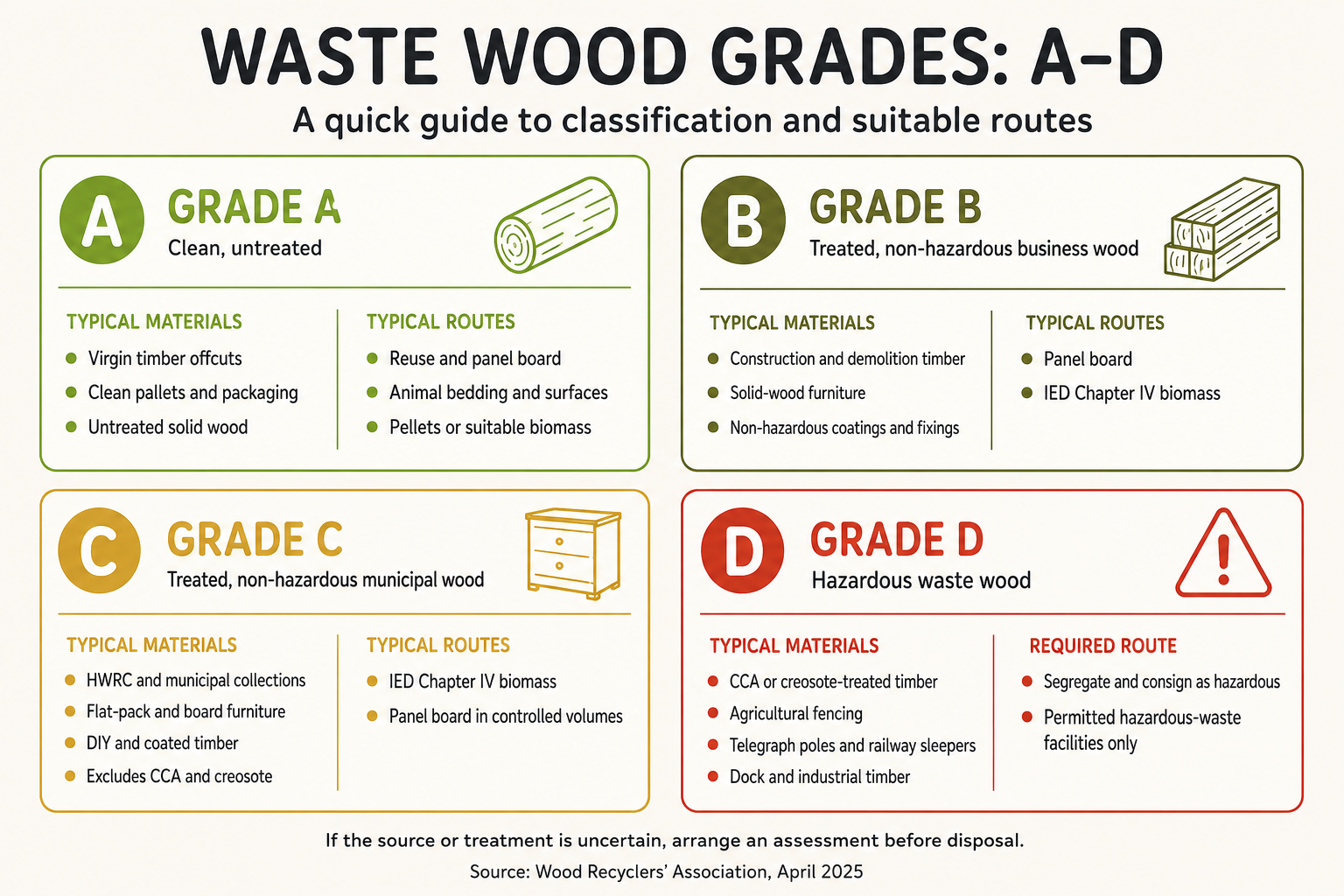
The Wood Recyclers’ Association groups waste wood into four grades according to its source, treatment and appropriate recovery or disposal route.

Which Types of Waste Wood May Still Be Hazardous?

Some forms of treated or contaminated timber remain hazardous and require specialist handling.

Typical examples include:

  • Wood treated with creosote
  • Wood treated with copper chrome arsenic, commonly known as CCA
  • Telegraph poles and railway sleepers
  • Agricultural fencing treated with hazardous preservatives
  • Timber from docks and other hydraulic engineering applications
  • Cooling tower timbers and certain other industrial wood
  • Wood from boats, carriages and trailer beds
  • Timber contaminated by hazardous chemicals or industrial processes

These materials should be separated from non-hazardous wood and transferred only to organisations and facilities authorised to handle hazardous waste.

Waste wood from heavy industrial premises may also require further assessment or testing.

When Might Testing Be Needed?

Although routine quarterly testing is no longer required, testing may still be appropriate when:

  • The source of the wood is unknown
  • Its previous use cannot be established
  • The type of treatment cannot be identified
  • It may have come into contact with hazardous chemicals
  • It originates from a heavy industrial building or process
  • Visual assessment and available records do not provide enough information for an accurate classification

Where testing is needed, it should be undertaken using an appropriate waste wood testing method and interpreted by someone competent in hazardous waste classification.

Your Waste Duty of Care

Businesses that produce, carry, store or manage waste have a legal Duty of Care.

This means taking reasonable steps to ensure that waste is:

  • Properly identified and classified
  • Stored securely
  • Kept separate where different classifications require it
  • Described accurately on the relevant documentation
  • Collected by an authorised waste carrier
  • Taken to a facility permitted to receive it

Non-hazardous waste normally moves under a waste transfer note. Waste classified as hazardous requires the appropriate hazardous waste documentation and must be sent to a suitably authorised facility.

If you are uncertain about the correct classification, seek advice before mixing the wood with other waste streams or arranging collection.

How Red Kite Recycling Can Help

Waste wood classification can be difficult when a project involves older premises, mixed demolition materials or timber of uncertain origin.

Red Kite Recycling can help you:

  • Review the types and sources of waste wood produced by your project
  • Identify materials that may need further assessment
  • Plan suitable segregation and storage arrangements
  • Arrange collection by an appropriately authorised carrier
  • Select a suitable recycling, recovery or disposal route
  • Maintain clear waste documentation and reporting

Good planning reduces the risk of non-compliance, avoids unnecessary hazardous waste costs and helps recover as much suitable wood as possible.

Find out more about our construction waste services or contact Red Kite Recycling for advice about waste wood from your site.

Telephone: 0333 880 3358
Email: Jolyon.Roe@RedKiteRecycling.com

Request a free waste audit.

Legislation Governing Builders’ Skip Permits

Overview

The placement of builders’ skips and containers on the highway is governed by the Highways Act 1980 Section 139. Within this a local authority is given discretion to determine the following:

  • The siting of the skip
  • Its dimensions
  • The manner in which it is to be coated with paint and other material for the purpose of making it immediately visible to oncoming traffic
  • The care and disposal of its contents
  • The manner in which it is to be lighted or guarded

This means that each local authority has its own interpretation of what constitutes a skip, and how it should be marked, located and lighted.

Specification of a builders’ skip

Within the regulations a builders’ skip means a container designed to be carried on a road vehicle and to be placed on a highway or other land for the storage of builders’ materials or the removal and disposal of builders’ rubble, waste, household and other rubbish or earth and shall, when carried on a road vehicle, comply with the appropriate Motor Vehicle Construction and Use Regulations.

In Bradford, for example, a skip is defined as a container that shall not exceed 5m in length and 2m in width. Whereas in Newcastle, for example, a 20ft storage container will be managed under a skip permit. Some councils have a scale of charges depending on the size of the skip, and others have a single price for any size.

Visibility

As a minimum:

  • The builders’ skip shall be clearly and permanently marked with the owner’s name and with his telephone number or address.
  • The container should be clearly visible at all times with vertical red and yellow fluorescent reflective markings at each end in accordance with the Builders’ Skips (Markings) Regulations 1984 (SI 1984/1933) (effective 1 January 1986) and BSS All 152 1970.
  • If on a highway then cones and lights are required to comply with Chapter 8 of the Traffic Signs Manual, and the ends shall be painted yellow. During the hours of darkness the owner shall provide, maintain and light four yellow lamps, fixed securely to the skip(s), one to each corner.
  • The skip(s) shall be placed in such a position as to be clearly visible to traffic approaching from either side at a distance of not less than 100m (330ft)
  • It shall neither be placed within a distance of 30m (100ft) from a road junction nor in such a position to block any sight line at an entrance, junction or bend nor to impede surface water drainage not obstruct access to property, fire hydrants, gullies, manholes and apparatus of any
  • Statutory Undertaker, nor be placed in such a position as to contravene any Traffic Order or regulation made under the Road Traffic Acts. It/they shall, when sited in the carriageway, be placed near the edge of the carriageway with the longer side parallel thereto.
  • It/they shall not be placed in such a position as to partly or wholly obstruct a footway without the express permission of the Strategic Director for Environment & Infrastructure or his representative, to be granted only after consultation and agreement with the police and conditional upon a one metre wide pedestrian walkway being provided in the carriageway, properly protected and signed and with yellow lights lighted at night.

Hoarding Licence

If a local authority deems that the skip falls outside of their interpretation of section 139 for a builders’ skip then they will often cite Highways Act 1980 section 169 which can be summarised as:

A license is required where building, demolition work or the alteration, repair, maintenance or cleaning of any building, requires to erect or retain on the highway any scaffolding or other structure which obstructs the highway (hereafter in this section referred to as a “relevant structure”).

The container is being considered as a ‘relevant structure’. The requirements of this relevant structure vary dependent on the local authority. Some may treat this as a construction site requiring hoarding, cones and illumination. Others may simply require a hoarding license.

What To Do

For every site we need to establish the ownership of the land upon which skips or containers are placed. Housing association land is most likely to be owned by the council and will require a permit.

Please notify Red Kite Recycling of any intended site at least a week in advance in order to determine ownership with the council, provide quotes, apply for any permits, and order the skips.


Call us if you would like an award-winning company to help you manage the recycling of your waste streams.

Construction

Manufacturing

Chemical & hazardous

Glazing