



Managing Hazardous Waste in Construction: A Practical Guide
Construction projects generate many different waste streams, from concrete and timber to paints, solvents, contaminated soil and asbestos-containing materials. Some may be hazardous, creating additional risks for people, the environment and the successful delivery of a project.
Managing hazardous waste in construction involves more than arranging a collection. Waste must be correctly identified, classified, segregated, stored and documented before being transferred through an authorised route in appropriate packaging for transportation.
This guide focuses on the requirements applying to construction projects in England. Different rules, documentation and regulators apply in Wales, Scotland and Northern Ireland

What Is Hazardous Construction Waste?
Waste is generally considered hazardous when it contains substances or displays properties that could harm human health or the environment.
Its status cannot always be determined by appearance alone. Product safety data sheets, site surveys, sampling or laboratory analysis may be needed before the correct classification and waste code can be assigned.
Hazardous construction waste can include:
- Asbestos-containing materials: Asbestos is a known carcinogen and requires carefully controlled handling and disposal. Before refurbishment or demolition begins, the building should have the appropriate asbestos survey. Some work may only be carried out by a contractor licensed by the Health and Safety Executive.
- Paints, solvents, adhesives and sealants: Uncured products and contaminated containers or cartridges may be hazardous, depending on their composition and the residues they contain. Empty packaging should not automatically be treated as non-hazardous.
- Lead-containing materials: Lead may be found in older paint, pipework, roofing and other building components. Its composition and concentration must be assessed before the correct waste code and disposal route can be confirmed.
- Lamps, batteries and electrical equipment: Fluorescent lamps containing mercury, certain batteries and some older electrical equipment contain hazardous substances. Not all electrical equipment is hazardous, so each waste stream must be assessed correctly.
- Contaminated soil: Soil affected by previous industrial activity, fuel storage, spills, asbestos or other contaminants is not automatically hazardous. Its classification depends on the substances present, their concentrations and the hazardous properties displayed.
- Treated timber: Timber treated with preservatives, creosote, paint or other chemicals may be hazardous. It should not be assumed to be suitable for the same recycling route as clean, untreated wood.
- Persistent organic pollutants: POPs may be present in some older electrical equipment, insulation products, sealants and plastics. Waste containing POPs above the applicable concentration limits must not normally be recycled or reused; the pollutants must be destroyed or irreversibly transformed through an authorised treatment route.
- Contaminated soil: Soil affected by previous industrial activity, fuel storage, spills, asbestos or other contaminants is not automatically hazardous. Its classification depends on the substances present, their concentrations and the hazardous properties displayed.
- Treated timber: Timber treated with preservatives, creosote, paint or other chemicals may be hazardous. It should not be assumed to be suitable for the same recycling route as clean, untreated wood.
- Persistent organic pollutants: POPs may be present in some older electrical equipment, insulation products, sealants and plastics. Waste containing POPs above the applicable concentration limits must not normally be recycled or reused; the pollutants must be destroyed or irreversibly transformed through an authorised treatment route.
Other Materials Requiring Separate Management
Some construction materials must be managed separately even though they are not normally hazardous.
Plasterboard and gypsum-based products are generally non-hazardous and are subject to landfill restrictions. It should be kept away from biodegradable waste as when the two are disposed of together in landfill, they can generate toxic hydrogen sulphide gas. Separating plasterboard also protects its potential for recycling.
Waste tyres are not generally hazardous, but whole and shredded tyres are subject to landfill restrictions. They should be sent through an appropriate reuse, recycling or recovery route.
Hazardous Waste Regulations in England
Construction businesses have a legal duty of care to manage waste without harming people or the environment. Waste must be correctly identified and classified before it is collected, treated, recovered or disposed of.
This normally involves assigning the appropriate Waste code, called an EWC code, and determining whether the material displays hazardous properties. Some materials have “mirror entries”, meaning the same general waste type can be hazardous or non-hazardous depending on its composition.
The Environment Agency’s WM3 technical guidance provides the framework for classification. Because this can be technically complex, specialist assessment or laboratory analysis may be required.
Hazardous-waste movements must normally be accompanied by a correctly completed consignment note. Producers and holders must generally retain their consignment notes and associated records for at least three years.
A Site Waste Management Plan is no longer a universal legal requirement in England. However, a documented plan remains good practice and may be required by a client, contract or planning condition.
How to Manage Hazardous Waste on a Construction Site
A clear process helps protect site teams, prevent contamination and provide an auditable record of how waste has been managed.
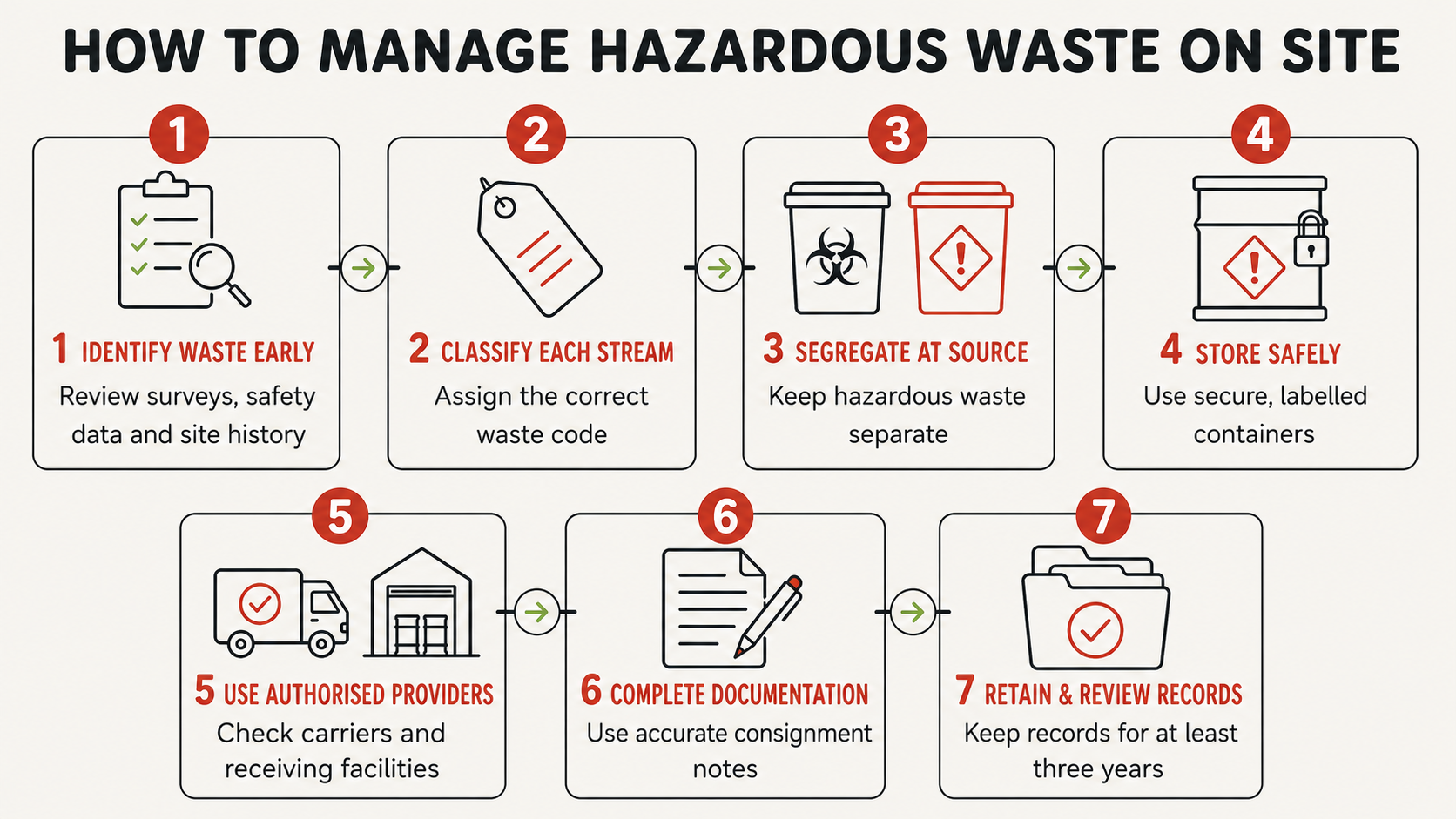
1. Identify Waste Before Work Starts
Review the project scope, building information, asbestos records, refurbishment or demolition surveys, safety data sheets and the site’s previous use. Early identification makes it easier to plan suitable containers, storage, collections and specialist support.
2. Assess and Classify Each Waste Stream
Assign the correct waste code and establish whether the material is hazardous. Do not rely solely on appearance or a generic description.
The government’s construction and demolition waste guidance provides codes for many common materials.
3. Segregate Waste at Source
Hazardous waste must not be mixed with non-hazardous waste, or with another category of hazardous waste, except in limited circumstances permitted by law.
Placing hazardous material in a mixed-waste skip can contaminate the entire load, prevent recycling and lead to rejection, delays and considerably higher costs. Clearly labelled containers and designated storage areas help site teams use the correct waste stream.
4. Store Waste Safely
Use suitable, compatible containers protected from damage, leaks and weather. Containers should be clearly labelled and stored securely.
Liquids may require sealed containers and secondary containment or bunded storage. Site arrangements should also consider fire safety, vehicle movements and unauthorised access.
5. Use Authorised Carriers and Facilities
Check that the waste carrier is properly registered and that the receiving facility’s environmental permit allows it to accept the relevant waste type and code.
Using a broker or waste-management provider can simplify the process, but the producer’s duty of care does not disappear when waste is handed to another business.
6. Complete the Correct Documentation
Most hazardous-waste movements in England require a consignment note. This must accurately describe the waste, its classification, quantity, packaging and hazardous properties.
The relevant sections must be completed by the correct parties and checked before the waste leaves the site.
7. Retain and Review Records
Keep consignment notes and supporting records organised and accessible for at least three years. Review information returned by the receiving facility to confirm where the waste went and how it was treated, recovered or disposed of.
Why Effective Segregation Matters
Effective segregation protects site workers and waste handlers while preventing recyclable materials from becoming contaminated. It also reduces the likelihood of rejected loads, avoids unnecessary hazardous-waste disposal costs and improves the accuracy of project reporting.
Every construction project produces a different combination of materials. Its waste-management arrangements should therefore reflect the waste streams, available space, working practices and collection requirements of the individual site.
How Red Kite Recycling Can Help
Red Kite Recycling supports construction businesses with complex waste streams across single and multiple sites. We help customers establish practical arrangements for hazardous and non-hazardous waste, working with appropriately authorised carriers, treatment providers and local recyclers.
A Free Waste Audit can identify likely waste streams and highlight opportunities to improve segregation, storage, collection and reporting. Where specialist surveys, testing or laboratory analysis may be required, this can be identified during the planning process.
We can also coordinate appropriate collection and treatment routes for individual waste streams. Working with suitable local recyclers where possible helps control haulage distances and costs while maintaining responsive customer service.
Our online reporting portal provides visibility across sites and waste streams. Documentation, weights, costs and supporting information can be held in one place, helping project teams maintain accurate records and make informed decisions.
Take Control of Hazardous Construction Waste
Managing hazardous waste in construction protects people, safeguards the environment and reduces the risk of costly disruption. The key is to plan early, classify waste correctly, segregate it at source and maintain a clear record of every collection.
Red Kite Recycling provides construction waste management and chemical and hazardous waste services for projects across the UK, adapting each solution to the waste streams and regulatory framework involved.
Book your Free Waste Audit and make hazardous-waste management simpler.
This article provides general information and should not be treated as project-specific legal, environmental or health and safety advice.

Article by
Jolyon Roe
Founder & Director of Red Kite Recycling,
20+ years in commercial waste management

 Back to blog